
Japan and Canada have committed to a new Strategic Partnership ... Read the full article
In March this year, Prime Ministers Sanae Takaichi and Mark Carney met in Tokyo and released a Joint statement on Canada-Japan Comprehensive Strategic Partnership. It commits the nations to deepening cooperation on defense, security, trade, investment, technology, climate policy, energy and food.
One of the strategy’s six priorities is fostering “People‑to‑People, Academic, and Cultural Exchanges”. JSAC has been doing this since 1987, and we are ready, able and eager to continue.
In the wake of last year’s terrific JSAC conference at the University of Lethbridge, Brock University’s Atsuko Hashimoto, Dave Telfer and Miya Narushima stepped up to organize our October meetings. Their hard work will deliver another fine weekend of Japan studies and catching up with old and new friends. There will be 6 keynotes and at least 50 presenters, including panels.
I am delighted to confirm that JSAC 2027 is being organized by Shige Matsui at the University of British Columbia, tentatively October 14-17. We appreciate Shige, the Brock team and the others who have sustained JSAC for 4 decades.
Another exciting initiative is that JSAC and the Canadian Association for Japanese Language Education (CAJLE), both founded in the late 1980s, will celebrate the 100th Anniversary of Canada-Japan official diplomatic relations by holding concurrent conferences in Ottawa, in summer 2028. This will be a wonderful opportunity for these Associations to display their commitment to Japan studies in Canada. We will keep you posted on the plans.
Vancouver was the setting for an important panel, “A Sustainable Future of Japanese Studies: Canada’s Perspective and Direction” at the Association for Asian Studies conference in March. The panelists were Mika Kimura (Victoria, President, CAJLE), Anne Commons (Alberta), Jérémie Pelletier-Gagnon (Université de l'Ontario français), Phillip Lipscy (Toronto) and Vincent Mirza (Ottawa), and I chaired. Key points expressed included the complementarity of Japanese language and studies courses and the need to cooperate across institutions. The panel was expertly organized by Noriko Yamamoto (Executive Director) and Ayeshwini Lama (Program Officer) of the Japan Foundation (Toronto) who also led the compilation of the Directory for Japanese Studies Institutions in Canada.
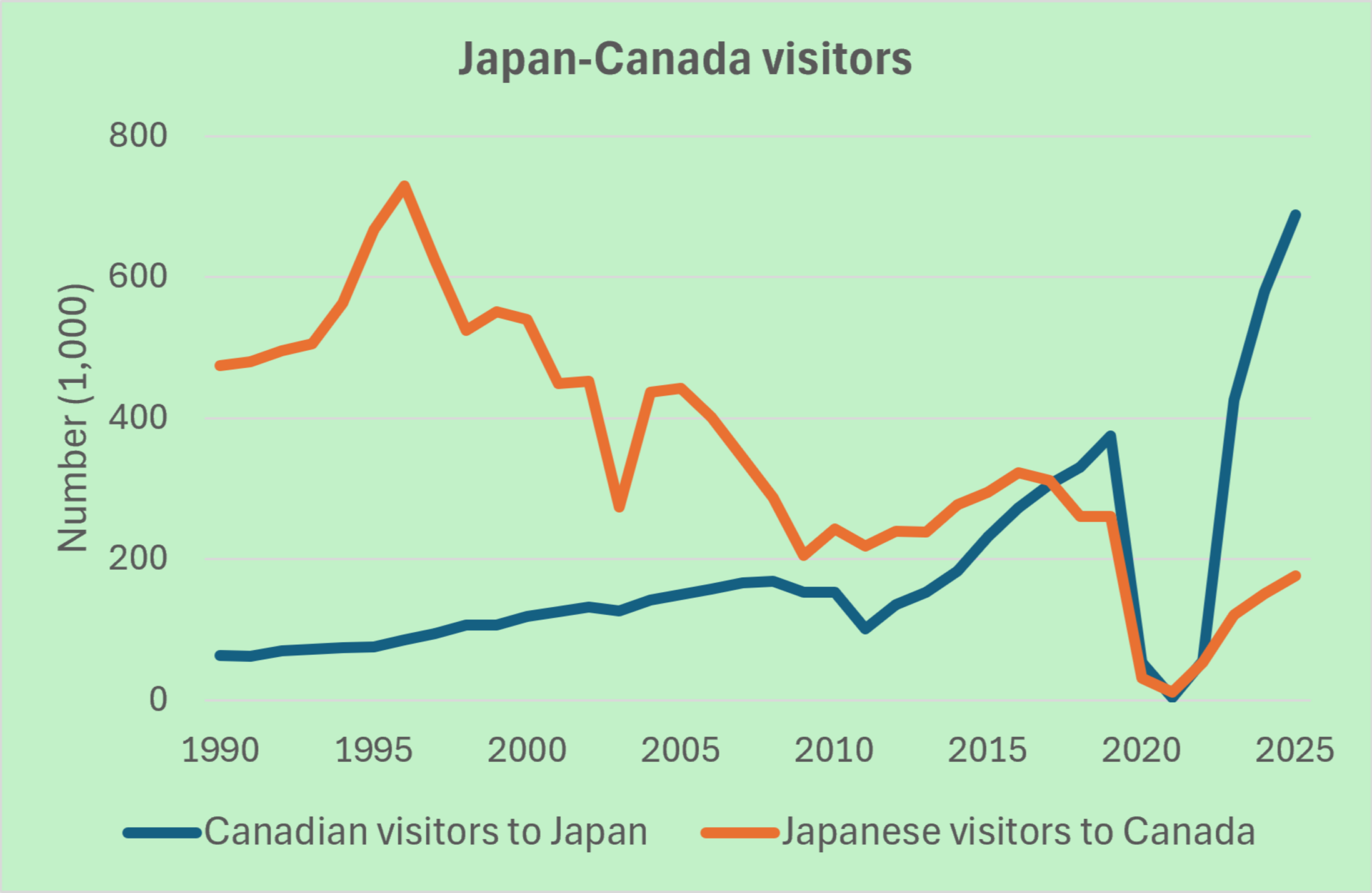
Finally, a note on the chart, created with Japan National Tourist Association and Statistics Canada data. Historically, many more Japanese have visited Canada, than vice versa. However, in 2018, 2019 and post-pandemic the balance has dramatically reversed as the numbers of Canadian travelers to Japan increased. The shift is largely due to the extraordinary growth in Japan’s international popularity as a tourist destination. In 1990 Japan welcomed 3.2 million visitors; in 2025 the number was 42.7 million. (Total overseas trips by Japanese dipped from 20 million in 2019, to 15 million in 2025.)
The world, including Canadians, are discovering what we have known for a long time. Japan is an interesting and important country.
James (Jim) H. Tiessen, Toronto Metropolitan University
President, JSAC